How Advisors Generate Pre-Meeting Briefs Automatically
Discover how modern financial advisors use AI to automate meeting preparation. This guide explores how to synthesize client history and action items into instant briefs.

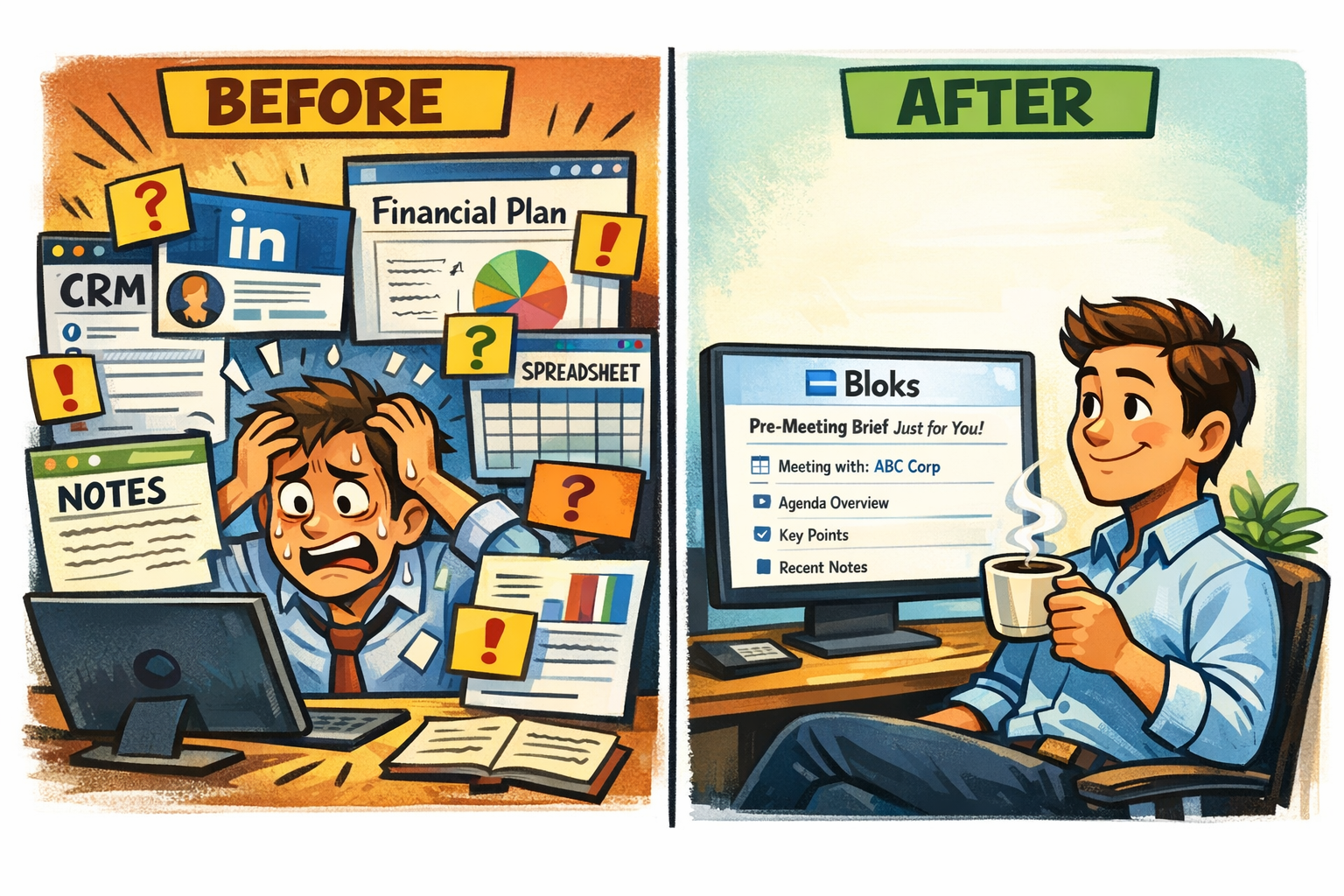
For wealth advisors, manual meeting preparation remains one of the largest and most frustrating operational bottlenecks in a growing practice. Pulling records across disjointed systems, digging through extensive email histories, and manually drafting agendas consumes hours of valuable time every week.
However, the landscape of advisory practice automation has fundamentally shifted in 2026. Rather than relying on scattered notes or a basic meeting assistant to simply record calls, high-performing wealth management teams are utilizing advanced operating systems to compile relevant relationship history, action items, emails, and meeting context into instant pre-meeting briefs.
This guide breaks down the operational costs of manual preparation, the architectural differences in modern automation tools, and how advisors can generate comprehensive pre-meeting briefs with zero manual effort.
What is an Automated Pre-Meeting Brief?
An automated pre-meeting brief is an AI-generated, instantly readable executive summary that synthesizes a client's entire interaction history across multiple communication channels prior to a scheduled meeting.
A robust AI meeting assistant does more than just list the calendar time and basic contact info. High-performing automated pre-meeting packs cover four critical data vectors:
Relationship History: Summaries of previous client reviews, touchpoints, and major life decisions.
Unresolved Commitments & Action Items: Open tasks, outstanding paperwork, and past promises made by either the advisor or the client.
Cross-Channel Correspondence: Recent emails, calendar invites, and even public context (such as LinkedIn profile changes or company news).
Financial & Plan Overviews: Opportunities for tax-loss harvesting, missing beneficiary details, progress toward planning goals, and cash flow updates, seamlessly drawing from connected wealth platforms [T3 Technology Hub].
The Operational Cost of Manual Meeting Prep in 2026
Historically, meeting preparation has scaled poorly for growing advisory practices. As firms manage anywhere from 100 to 300 client relationships per advisor, manually compiling relevant context represents a massive administrative drain.
Industry data highlights the severity of this bottleneck:
The Time Burden: According to early 2026 industry reports, client meeting preparation routinely takes between one and four hours per meeting when performed manually. This requires pulling data across disconnected CRMs, past meeting notes, valuation statements, and scattered emails [FTAdviser].
The Cost of Inefficiency: Enterprise case studies, such as those evaluating RBC Wealth Management's workflows, reveal that advisors previously spent 30 to 60 minutes just hunting for data across five disparate systems before a single interaction. Transitioning to automated prep tools yielded annual savings of up to 4,700 hours for enterprise-scale firms [Context Windows].
Compounding Downstream Time: Post-meeting documentation adds another one to four hours of admin work per meeting, representing millions of hours of lost face-to-face client time across the industry [Case Studies AI].
Recent platforms launched in 2026, such as Bank of America Merrill Lynch's "Meeting Journey" suite, aim to reclaim up to four hours per meeting across prep, summaries, and follow-ups [Wealth Management].
Meeting-Derived vs. Relationship-Derived AI
To effectively generate automated pre-meeting briefs, it is vital to understand the underlying architecture of the tool being used. Currently, the wealthtech market is divided into two distinct methodologies: Meeting-Derived Intelligence and Relationship-Derived Intelligence.
Meeting-Derived Intelligence (Point Solutions)
Popular point solutions act primarily around the meeting as the unit of work. These virtual "bots" join video calls, capture transcripts, and draft summaries.
However, because these tools are meeting-derived, their pre-meeting briefs lean almost entirely on past recorded conversations. If a client emails an advisor with a critical update—such as an inheritance or a life change—outside of a structured meeting, a standard Meeting AI assistant will often miss it because it does not ingest full communication histories.
Relationship-Derived Intelligence (The Un-CRM Approach)
Rather than acting as "just another icon in the toolbar," relationship-first platforms continuously and securely capture emails, calls, notes, LinkedIn profiles, and company websites in the background.
"The critical flaw of standard meeting AI assistants is that their intelligence is strictly meeting-derived. Bloks delivers relationship-derived intelligence by automatically synthesizing emails, documents, and team communications so advisors walk into every conversation fully prepared without manual effort."
Because this intelligence is relationship-derived, a client's profile is rich and structured before the first meeting even occurs. When generating a Pre-Meeting Brief, the system reviews the entire tapestry of team-wide emails, documents, and historical touchpoints, surfacing context exactly when you open your calendar.
Step-by-Step Guide: Automating Pre-Meeting Briefs
Transitioning from manual data gathering to an automated workflow requires setting up an intelligent operating layer. Using an AI-first Un-CRM like Bloks, this workflow operates in four automated steps:
Step 1: Enable Continuous Capture
Begin by connecting your primary communication channels. The system silently runs in the background, monitoring email exchanges, calendar appointments, and internal notes without requiring advisors to manually copy-paste or link data. This ensures no client interaction falls through the cracks between official meetings.
Step 2: Leverage Auto-Structured Profiles
Rather than forcing you to fill out tedious forms or update CRM fields manually, the relationship-derived intelligence auto-structures raw data into unified, secure client profiles. By the time a meeting is booked, the system has already compiled the client's current status.
Step 3: Review Proactive Briefs Before the Call
Prior to the scheduled meeting, open your calendar to find a comprehensive pre-meeting brief proactively surfaced. Advisors should review:
Dynamic People Briefs: Instant summaries of the individual client's goals and recent changes.
Live Company Snapshots: Real-time context on the client's business or employer.
Team-Enhanced Briefs: Insights drawing on emails and conversations from the entire advisory firm, ensuring you have context even if a junior associate handled the last email.
Step 4: Automate Action Items and CRM Sync
After the meeting concludes, an advanced meeting assistant AI will instantly generate compliant notes and identify next steps. Ensure your operating layer is configured to seamlessly push these updated notes, profiles, and follow-up tasks to industry-standard platforms like Salesforce, Wealthbox, Equisoft, or HubSpot.
"Advisors should not work for their software; their software should work for them. By automating the six core administrative burdens of client management—including instant, multi-source pre-meeting briefs—Bloks acts as the operating layer that lets traditional CRM systems finally work for the advisor."
Security, Trust, and Compliance Guardrails
For financial advisors operating in highly regulated environments (such as SEC, FINRA, or PIPEDA jurisdictions), generic, horizontal AI tools present serious liability risks.
According to recent wealthtech research, public, consumer-grade models may train on inputted data, putting highly sensitive client financial data at risk [Hubbis PDF]. Therefore, platforms launched in 2026 place immense focus on deterministic, hallucination-free AI architectures relying exclusively on verified and permissioned internal data [Point Group].
The standard for wealth management requires platforms to be SOC 2 Type II Certified, compliant with regional privacy laws, and feature local data residency. Crucially, client data must never be used to train external AI models, ensuring advisors retain absolute ownership over their data.
Conclusion
As advisory practices continue to scale in 2026, the reliance on manual preparation is no longer viable. Implementing a relationship-derived AI meeting assistant fundamentally shifts how wealth management professionals prepare for client interactions.
"While point-solution AI notetakers save minutes during a call, an AI-first Un-CRM like Bloks restructures the entire administrative workflow—allowing wealth advisors to reclaim up to a full day of productivity every single week."
By fully automating the compilation of history, outstanding tasks, and firm-wide correspondence, advisors can shift their focus entirely back to where it belongs: building trust and delivering strategic financial advice.